Is GPS Capitalized?
Introduction:
Are you a frequent user of maps and navigation apps? Do you find yourself constantly typing in the acronym "GPS"? If so, you've probably wondered, "Is GPS capitalized?" The answer to this question is a simple yes, but there's more to it than just knowing when to capitalize.
# 2. GPS: What Does It Mean?
GPS, short for Global Positioning System, is a satellite-based navigation system that provides location and time information to receivers on Earth. It's widely used in cars, airplanes, smartphones, and various other devices.
# 2.1. When to Capitalize
When using GPS in writing, it's always capitalized because it's a proper noun. Proper nouns are specific names of people, places, and things.
# 2.2. When Not to Capitalize
However, there are times when GPS may not be capitalized. For example, when it's used as a generic term for any satellite navigation system, it can be written in lowercase.
# 3. GPS Technologies
GPS satellites use a combination of technologies to determine their position and time, including:
# 3.1. Radio Navigation Signals
GPS satellites transmit radio navigation signals that are received by GPS receivers on Earth.
# 3.2. Atomic Clocks
GPS satellites have precise atomic clocks that keep accurate time synchronization.
# 3.3. Trilateration
GPS receivers calculate their position by measuring the distance from three or more GPS satellites using a technique called trilateration.
# 4. GPS Applications
GPS has a wide range of applications, including:
# 4.1. Navigation
GPS is primarily used for navigation in cars, airplanes, boats, and even hiking.
# 4.2. Tracking
GPS can be used to track vehicles, people, and animals for security and safety purposes.
# 4.3. Surveying
GPS is used in surveying to accurately measure distances, elevations, and boundaries.
# 5. GPS Benefits
Using GPS offers numerous benefits, such as:
# 5.1. Improved Accuracy
GPS provides highly accurate location information, making it a reliable navigation tool.
# 5.2. Real-Time Tracking
GPS allows for real-time tracking of moving objects, enabling better asset management and emergency response.
# 5.3. Convenience
GPS makes navigation easier and more convenient, reducing the risk of getting lost.
# 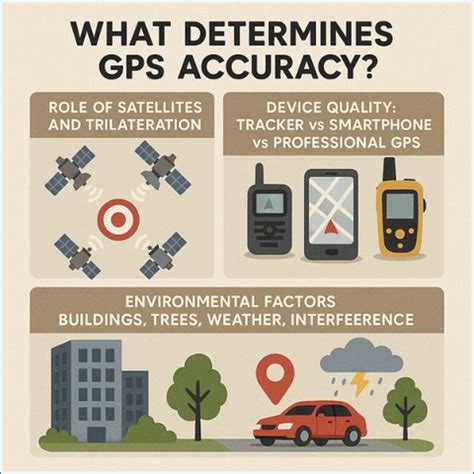
GPS accuracy can vary depending on several factors, including:
# 6.1. Number of Satellites
The more GPS satellites visible to a receiver, the better the accuracy.
# 6.2. Satellite Geometry
The geometry of the satellites in the sky can impact accuracy.
# 6.3. Atmospheric Conditions
Atmospheric conditions can sometimes interfere with GPS signals.
# 7. GPS Limitations
While GPS is a very useful technology, it does have some limitations:
# 7.1. Signal Blockage
GPS signals can be blocked by physical barriers such as buildings or tunnels.
# 7.2. Spoofing
GPS signals can be spoofed or manipulated, potentially leading to inaccurate navigation.
# 7.3. Privacy Concerns
GPS data can be used to track people's movements, raising privacy concerns.
# 8. Advanced GPS Systems
In addition to traditional GPS, there are several advanced GPS systems, including:
# 8.1. GLONASS
GLONASS is a Russian satellite navigation system similar to GPS.
# 8.2. Galileo
Galileo is a global navigation satellite system developed by the European Union.
# 8.3. BeiDou
BeiDou is a Chinese satellite navigation system with regional coverage.
# 9. Tips for Using GPS Effectively
To use GPS effectively, consider these tips:
# 9.1. Calibrate Your Device
Regularly calibrate your GPS device to maintain accuracy.
# 9.2. Check Your Signal Strength
Ensure you have a strong GPS signal before relying on it for navigation.
# 9.3. Use Maps and Apps
Use reliable maps and navigation apps to complement your GPS.
# 
GPS has become an essential part of our daily lives, used in numerous ways, such as:
# 10.1. Transportation
GPS is widely used for navigation in cars, public transportation, and airplanes.
# 10.2. Personal Safety
GPS can be used for safety purposes with features like emergency calls and location sharing.
# 10.3. Leisure Activities
GPS enhances outdoor activities such as hiking, biking, and geocaching.
# 11. GPS Trends
The future of GPS technology is promising, with advancements such as:
# 11.1. Improved Signal Strength
Ongoing research focuses on improving GPS signal strength and accuracy.
# 11.2. Integration with other Technologies
GPS is becoming more integrated with other technologies, such as vehicle-to-vehicle communication and augmented reality.
# 11.3. Personalization
GPS devices and apps are becoming more personalized, offering tailored recommendations and experiences.
# 12. Frequently Asked Questions (FAQs) about GPS
1. Is GPS free to use?
Yes, GPS is a free service provided by the US government.
2. Do I need data or internet access to use GPS?
No, GPS does not require data or internet access.
3. Can I use GPS indoors?
GPS signals can be weak or blocked indoors, making it less reliable.
4. Is GPS accurate everywhere?
GPS accuracy can vary depending on factors such as satellite availability and atmospheric conditions.
5. Can GPS be used for tracking?
Yes, GPS can be used to track vehicles, people, and animals.
6. Are there any advanced GPS systems besides GPS?
Yes, there are other advanced GPS systems like GLONASS, Galileo, and BeiDou.
7. Can GPS be used for entertainment purposes?
Yes, GPS is used in augmented reality games like Pokémon GO.
8. What are the limitations of GPS?
GPS accuracy may be affected by factors like signal blockage and spoofing.
9. How can I improve the accuracy of my GPS device?
Calibrate your device regularly and ensure a strong signal.
10. Is GPS reliable for emergency situations?
While GPS can provide location information, it's not always reliable in emergencies.
# 13. Conclusion
GPS, a revolutionary technology that has transformed our world, is a vital part of our daily lives. Understanding the basics of GPS, its applications, and limitations can help you get the most out of this powerful tool. As the technology continues to advance, you can expect even more innovative and exciting ways to use GPS in the future.
# SEO-Keywords
- GPS definition
- GPS applications
- GPS accuracy
- GPS limitations
- Advanced GPS systems
- GPS FAQs
- GPS in everyday life
- GPS trends
